
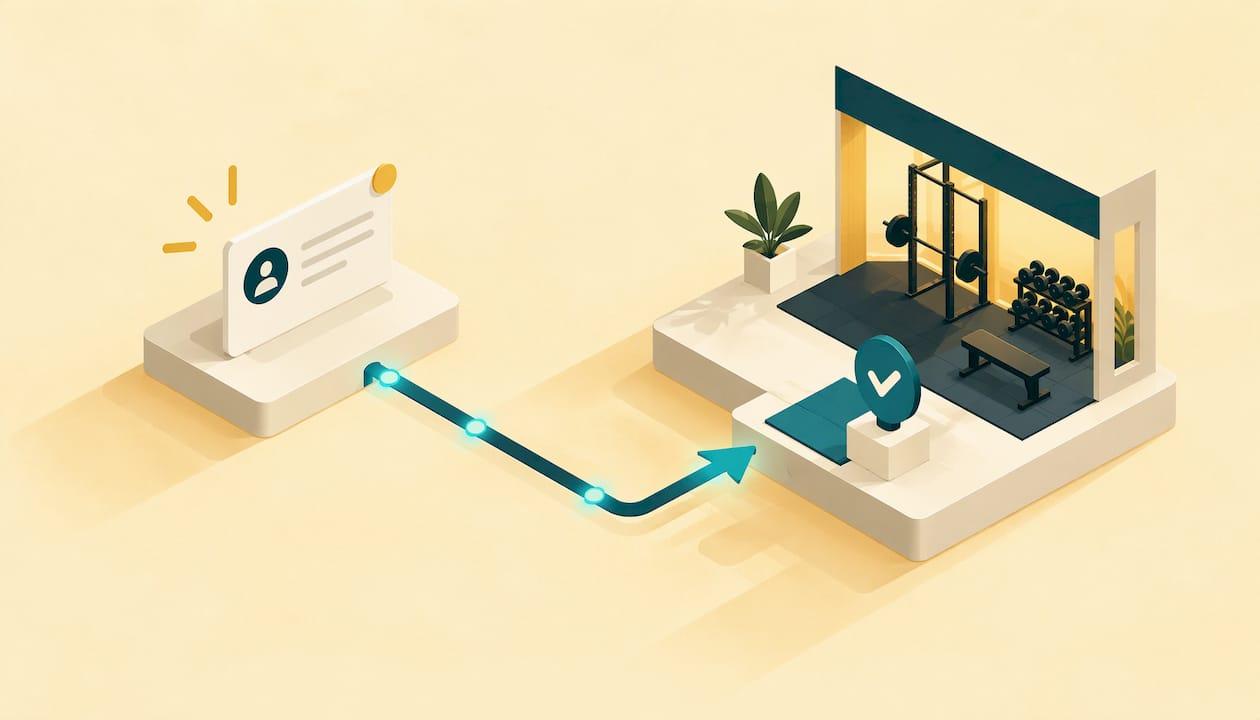
AI lead response is software that answers a new inquiry the moment it arrives, whether it came from a website form, an ad, a text or a missed call. It then asks a few qualifying questions and books the person into an intro class, with a human stepping in when needed. For a martial arts gym or fitness studio, it closes the gap between "someone raised their hand" and "someone is on the schedule," which is where most paid leads quietly die.
This guide covers what AI lead response is, how it differs from lead generation, what a good first-response sequence looks like, how to set it up, how to measure it and what the texting rules require.
TL;DR
- AI lead response converts demand you already paid for. It replies instantly, qualifies, and books trials. It does not create new leads on its own.
- Speed is the weak point in the industry: a 2025 study of 99 North American gym brands found only 20% responded within an hour.
- A good setup has six parts: capture, first reply, qualification, routing, follow-up and CRM tracking, with a clear handoff to staff.
- Measure contact rate, trial bookings, show-ups and memberships signed, not just reply speed.
- Automated texting needs consent records, opt-out handling and human oversight. AI does not exempt you from existing rules.
Table of Contents
- What AI lead response is, and what it is not
- Why speed decides who gets the trial
- What a good first-response sequence looks like
- Qualifying leads and booking intro classes without losing the human touch
- Channels and gym systems AI lead response can work with
- How to set up an AI lead-response workflow
- Our perspective: speed is a system problem, not a willpower problem
- Measuring whether it works
- Privacy, texting rules and customer experience
- Done-for-you AI lead response for martial arts gyms
- FAQ
- Sources
What AI lead response is, and what it is not
A lead comes in. Within seconds, the system replies in your gym's voice, answers basic questions, asks what the person is looking for and offers times for a trial class. If the person goes quiet, it follows up. If the question is unusual, it hands the conversation to you or your front desk.

That is different from AI lead generation. Practitioners split AI lead work into two jobs: inbound AI works on people who already found you, while outbound AI goes looking for people who have never heard of you. Lead response is the inbound job. Your ad, your Google listing, your Instagram profile or your website did the finding. The response system does the converting.
It also differs from general marketing automation. Broad campaign tools send newsletters and promotions to a list whether or not anyone just reached out. A response system starts from a specific person who just asked a specific question, and its job is to acknowledge them, understand why they wrote and make the next step obvious.
The goal is not to close a membership by text. It is to get a nervous beginner, a parent shopping for kids' classes or a lapsed athlete from "curious" to "standing on the mat for a trial." Coaches sell the membership once the person is in the room.

Why speed decides who gets the trial
Most gyms respond slowly, and most prospects shop more than one place. The Fitness Industry Technology Council published a Keepme study of 99 North American gym brands covering 13,155 locations. Its findings:
- Only 2.02% of operators actively advertise a call-back function.
- Of those, 60.47% failed to attempt a call-back at all.
- Only 20% of North American operators responded within an hour.
- The slowest responses took more than 5,000 minutes, over three days.
Those numbers describe large brands, but the pattern is familiar to any independent owner. You are teaching a 6 p.m. class when the form fills in. You see it at 9:30 p.m., text back the next morning, and by then the prospect has booked a trial somewhere else.
A martial arts gym has an extra problem: your owners and head instructors are on the mat during the exact hours people browse and inquire, which is evenings and weekends. Nobody is at the desk. Instant automated response fills that gap without adding a salary.
What a good first-response sequence looks like
The best sequences are short, human in tone and built around one question at a time. One practitioner reported that single-question messages lifted inquiry-to-booked-call rates from 8% to 23%. Treat that as one operator's result, not a promise, but the principle is sound: a wall of text invites a non-reply, a single easy question invites an answer.
Here is a sample flow for a kids' jiu-jitsu program.
- Instant reply (under a minute). "Hi Maria, thanks for reaching out to Riverside Jiu-Jitsu. Is this class for you or for your child?"
- One qualifying question at a time. Age, experience, goal. "How old is your son?" then "Has he tried martial arts before?"
- A specific offer. "We have a beginner kids' class Tuesday at 5:00 or Saturday at 10:00. Which works better?"
- Confirmation. Date, time, address, what to wear, parking, and a reply option if plans change.
- Reminders. A message the day before and a short one a couple of hours ahead.
- No-show and no-reply follow-up. A friendly nudge a day later, another after a few days, then a longer-term nurture.
Notice the offer is a choice between two times, not "let us know if you're interested." Choices get answered.
Qualifying leads and booking intro classes without losing the human touch
Qualification in a gym is simple and should stay that way. You are not scoring an enterprise buyer. You want to know:
- Who the class is for (adult, teen, child)
- Which program fits (Brazilian jiu-jitsu, karate, kickboxing, kids, fitness)
- Experience level
- Preferred days and times
- Whether they have a concern that needs a person (injury, age, budget, special needs)
The system books straight into your calendar when the answers are routine. It routes to staff when they are not. Set handoff rules in advance:
- Always hand off: injuries or medical questions, requests to speak to a person, complaints, anything involving a minor's special needs, questions about pricing exceptions or contracts.
- Hand off after a trigger: two unanswered attempts by the AI on an engaged lead, or a prospect who asks the same question twice.
- Never improvise: the AI should answer pricing, schedules, policies and class descriptions only from information you gave it. If it does not know, it should say a team member will follow up and flag the conversation.
Good handoffs also pass context. Staff should see the full conversation, the answers already collected and the lead's source, so nobody asks the same question again.
Channels and gym systems AI lead response can work with
Pick channels by where your leads actually arrive. For most martial arts gyms and studios that means:
- Website forms and landing pages. The most common source. Reply by text and email within a minute.
- Paid social lead forms. Facebook and Instagram ads often produce instant-form leads. These are the leads that cool fastest, so they benefit most. Our guide to Facebook ads for gyms covers the costs, setup and follow-up that go with them.
- Text messages. Prospects text the number on your door sign, Google listing or flyer.
- Missed calls. A missed call can trigger an immediate text asking how you can help, which often saves a lead that would otherwise vanish.
- Chat widgets and social DMs. Useful when your Instagram is a main discovery channel. See our martial arts social media marketing playbook for how that traffic builds.
Behind the channels sit your calendar and CRM. The response system should write every conversation to one record, check real availability before offering times and update the lead's status when a trial is booked, attended or missed. If your studio management software has its own AI add-on, compare it with a done-for-you system on what it covers. As of May 2026, AI add-ons from studio software platforms were listed at anywhere from $10 to $399 a month, and they differ in whether they handle ad leads, missed calls and reactivation or only in-app messaging.
How to set up an AI lead-response workflow
Start small and get one channel right before adding others.
- Map your lead sources. List every place an inquiry can land: forms, ad leads, texts, calls, DMs. Note which are most valuable, usually paid leads.
- Write your qualification rules. The five questions above, in the order you would ask them at the front desk.
- Load your real information. Class schedule, trial policy, age ranges, what to bring, location, parking, pricing you are willing to share, and the answers to your ten most common questions.
- Connect the tools. Form or ad source, phone number, calendar and CRM, so a booking lands in one place with no copy and paste.
- Write the message sequence. Short messages in your gym's voice, one question per message, with reminders and follow-ups.
- Define human handoffs. Who gets notified, how, and how fast they are expected to respond.
- Test the failures. Submit fake leads. Ask odd questions. Reply "stop." Try a double booking. Fix what breaks before real leads arrive.
- Launch on one channel, then expand. Add the next source once the first is converting cleanly.
For the bigger picture on feeding this workflow with the right traffic, see our practical gym lead generation system. If your focus is one-on-one coaching, the same follow-up logic applies to personal training leads.
Our perspective: speed is a system problem, not a willpower problem
Most gym owners do not have a lead problem. They have a lead-handling problem. They pay for ads, a website or a referral push, the inquiries come in, and then the person who could answer them is teaching, coaching or finally having dinner.
We built Blackbelt AI Systems around that gap. Our AI receptionist is designed to answer inquiries instantly, qualify them, book the intro session and keep following up around the clock, so owners can stay focused on coaching. We work exclusively with martial arts gyms and fitness studios, which means the scripts, the offers and the follow-up timing are built around how your students actually decide.
Our approach connects the whole chain: ad management that brings people in, an AI receptionist that responds, reactivation campaigns that revive old leads and CRM workflows that keep everything organized. Our clients have reported cost per lead as low as $0.74, and we design every piece so a lead that costs money to get is not wasted by a slow reply.
Our advice: do not start with fancy tools. Start by deciding what should happen in the first 60 seconds after someone inquires, then make it happen every time, at any hour.
Zach
Measuring whether it works
Speed is the first metric, not the only one. Track the whole path from inquiry to membership, and compare a period before launch with a period after.
| Metric | What it tells you | How to calculate |
|---|---|---|
| First-response time | Whether the system is replying fast | Time from inquiry to first reply, median |
| Contact rate | Whether leads engage at all | Leads who replied ÷ total leads |
| Trial booking rate | Whether conversations turn into bookings | Trials booked ÷ total leads |
| Show-up rate | Whether reminders and expectations work | Trials attended ÷ trials booked |
| Conversion rate | Whether the trial experience closes | Memberships signed ÷ trials attended |
| Cost per booked trial | Whether ad spend is paying off | Ad spend ÷ trials booked |
| Handoff rate | Whether the AI is over- or under-escalating | Conversations passed to staff ÷ total conversations |
Two cautions when reading results. First, compare by lead source, because a form lead from a parent searching Google behaves differently from an instant-form lead from a social ad. Second, watch the back half of the funnel. If bookings rise but show-ups or sign-ups do not, the problem is probably in the reminder sequence or the trial class experience, not the response.
The often-quoted statistic that companies responding within five minutes are far more likely to qualify a lead than those waiting 30 minutes comes from general B2B sales research and is not gym-specific. Use your own numbers: sort last quarter's leads by how long you took to reply and see what happened to each group.
Privacy, texting rules and customer experience
Automating replies does not remove your legal duties. Industry guidance for studios is clear that AI-driven texting, health-related data use and automated communication require consent, privacy controls and human oversight, and that AI does not remove obligations under the TCPA, FTC rules or data-security requirements. The same guidance notes the FTC has said there is no AI exemption from laws against unfair or deceptive practices.
In practice, before you turn on automated SMS:
- Keep consent records. Store when and how each person opted in, such as the form and the wording they agreed to.
- Honor opt-outs immediately. "Stop" must work on every channel, and the system should log it. FCC rules on revoking consent for calls and texts are changing the details, so confirm current requirements with your software provider and your attorney.
- Keep message logs. You want a record of what was sent and when.
- Be careful with health information. If a prospect mentions an injury or condition, route to a person and avoid storing more than you need.
- Be honest that it is automated when asked. Do not pretend a bot is a named staff member.
- Ask your attorney about state rules on texting and marketing consent. They vary, and a lawyer who knows your state is the right person to confirm your setup.
On customer experience, accuracy matters as much as law. An AI that quotes the wrong class time or invents a policy damages trust faster than a slow reply. Keep its knowledge limited to what you provided, review conversations weekly in the first month and update answers whenever your schedule or pricing changes.
Done-for-you AI lead response for martial arts gyms
If you would rather not build and maintain this yourself, that is what we do. Blackbelt AI Systems offers an AI receptionist for instant lead response and booking, AI paid ads on Facebook and Instagram, lead reactivation campaigns, custom site builds and funnels, and CRM and workflow automation, all built for martial arts gyms and fitness studios.

See how the pieces fit on our AI marketing services page, or book a free AI growth discovery call and we will walk through your current lead sources and where leads are slipping.
FAQ
What is AI lead response?
It is software that replies to a new inquiry instantly, at any hour, in your business's voice. It asks qualifying questions and sends the person to a booking link or your calendar. Staff take over when the conversation needs a human.
Is AI lead response the same as AI lead generation?
No. Lead generation finds new prospects, through ads, content or outreach. Lead response works on people who have already contacted you or filled out a form. Most gyms need both, but response is usually the faster fix because the leads already exist.
Will an AI replace my front desk or coaches?
It is designed to handle the repetitive first-contact work: answering common questions, booking trials and sending reminders. Coaches and staff still run classes, handle sensitive conversations and sign members. Clear handoff rules keep people in charge of anything complicated.
Do I need consent to text leads automatically?
Yes, automated texting requires proper consent and opt-out handling under federal rules such as the TCPA, and some states add their own. Keep records of how each lead opted in and make "stop" work everywhere. Confirm your setup with an attorney familiar with your state.
How fast should a gym respond to a new lead?
As fast as possible, ideally within a minute. A 2025 study of North American gym brands found only 20% responded within an hour, so a reply in seconds sets you apart. Automation is the practical way to do it during classes and after hours.
Sources
- Keepme study via the Fitness Industry Technology Council: call-back services in North American membership sales
- Studio Software Advice: How AI is changing fitness studio software in 2026
- Dorian Media Group: AI lead generation, what works now
- Prospeo: AI lead responder, what it is and how to set one up